
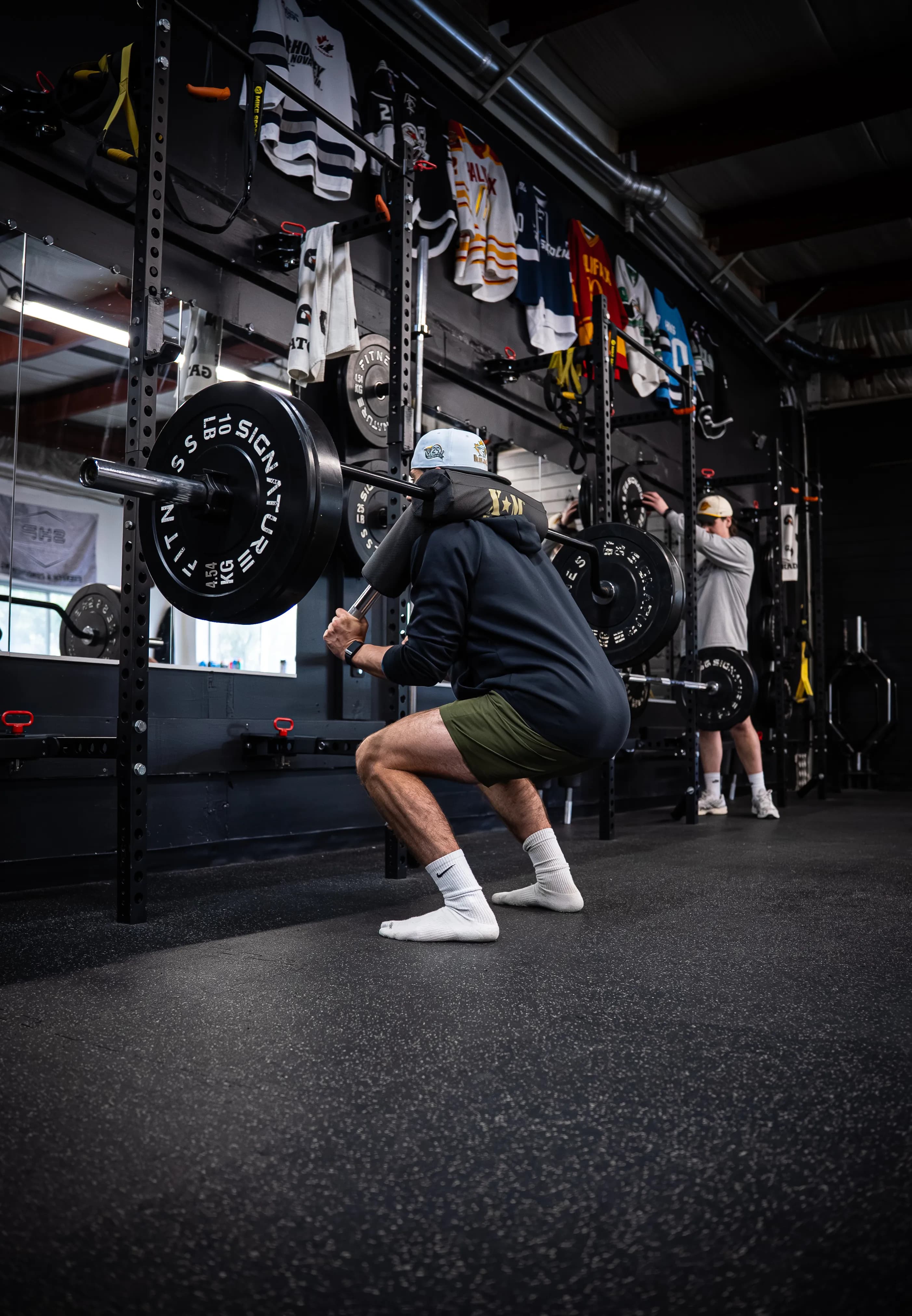
Don't Lose What You Spent the Summer Building.
In-season training isn't about getting stronger. It's about staying strong, staying fast, and being ready to perform when it counts.
The In-Season Problem
Most hockey players stop training when the season starts. They think games and practices are enough. They're wrong, but the answer isn't to train the same way you did in July.
In-season training has one job: maintain the physical qualities you developed in the off-season, manage fatigue so you can perform in games, and keep you healthy across a full season. That requires a completely different approach than off-season work.
At SHP, in-season programming is built around one principle: the game is the priority. Training supports it.
Fatigue Monitoring: The Core of In-Season Work
The biggest mistake in-season athletes make is training blind. They don't know if they're fresh or depleted. They push hard on days they should back off. They go through the motions on days they had capacity. Both are costly.
We use RSI-mod (Reactive Strength Index Modified) monitoring through the SHP Platform to track neuromuscular readiness across the season. Every training session starts with a quick jump assessment. The data tells us what your nervous system is ready for that day. High output means we can push. Low output means we manage.
This isn't a workaround. It's how professional programs manage in-season athletes. It's why some players show up to the playoff push fresher than they were in October. Others are running on empty by February.
What In-Season Programming Looks Like
Reduced Volume, Maintained Intensity
In-season programs are shorter and lower in volume than off-season work. That's by design. The goal isn't to accumulate more. It's to send the right signal to maintain strength and power while the body recovers from the game demands of a full schedule.
Session Timing Around Games
Your program accounts for your game schedule. We build in appropriate windows between sessions and games so you're never going into a game with residual fatigue from a heavy training day.
Velocity-Based Loading
VBT stays in the program in-season because it's the best fatigue management tool we have. On days when your velocity is off, the load adjusts automatically. You get the stimulus you need without the cost you can't afford mid-season.
RSI-mod Readiness Tracking
Jump data gets logged regularly across the season. That longitudinal picture tells us how your neuromuscular system is holding up, when you need a deload, and whether fatigue is accumulating faster than you're recovering. Your coach can see this data in real time.
Who It's For
In-season programming is for athletes who refuse to let the season erode what they built. The players who maintain their physical output through January and February while others are declining are the ones who trained smart, not just hard.
We work with players from U15 through professional. If you have a season and you want to protect your off-season investment, this is for you.